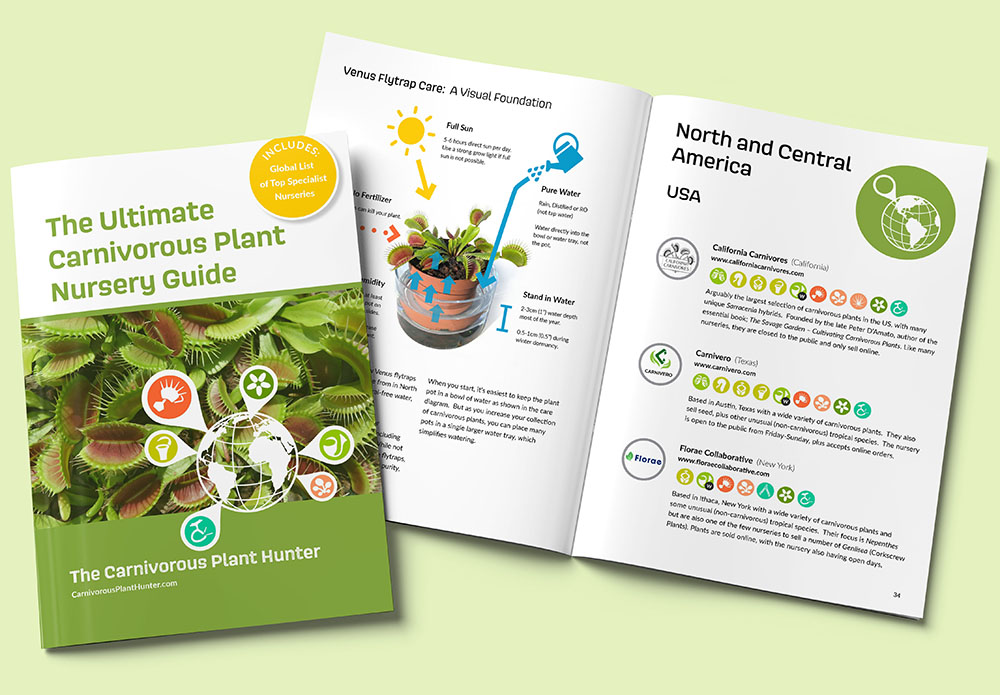
The Ultimate Carnivorous Plant Nursery Guide - Preview Edition

Where to Buy Carnivorous Plants, How to Grow Them, and Why Their Wild Habitats Hold the Key

A new unique Nepenthes hybrid being bred at Borneo Exotics, Sri Lanka.

Photo credit: James Haig Streeter

Introduction

If you’re just beginning your journey into the world of carnivorous plants, you’ve probably already asked one of the most common questions in the hobby:

“Where can I buy carnivorous plants — and how do I keep them alive?”

Carnivorous plants are among nature’s most extraordinary predators — elegant, specialized, and far more diverse than people typically realize. Most people discover carnivorous plants through photos, botanic gardens, or field encounters. But the species you see online or in the wild are rarely found in garden centers. 

While a garden center might offer a Venus flytrap or a typical pitcher plant (and many carry none at all), more than 800 species exist in the wild, spanning every continent except Antarctica.


Most new growers never encounter this diversity.
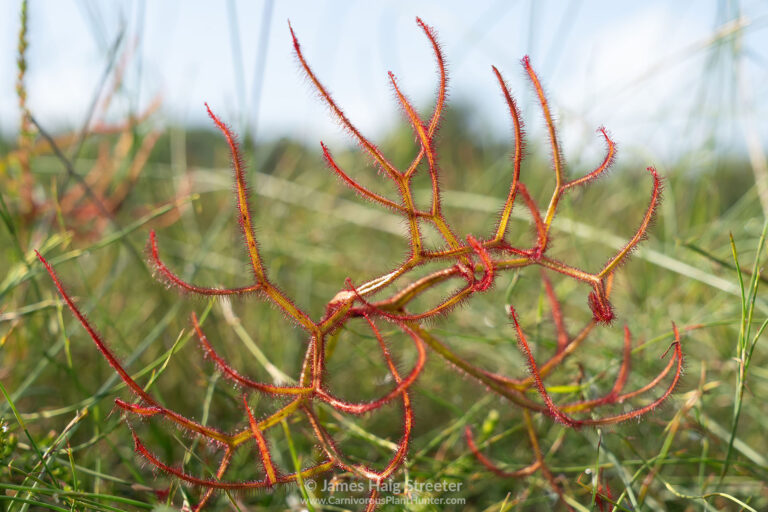
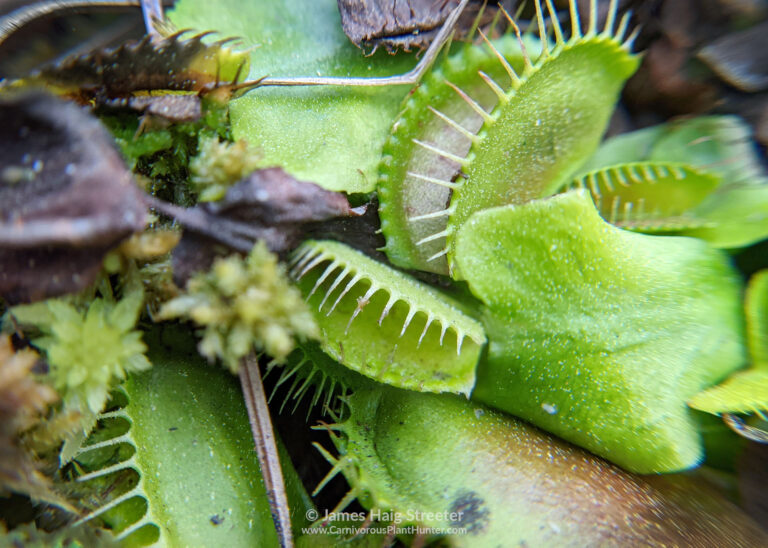
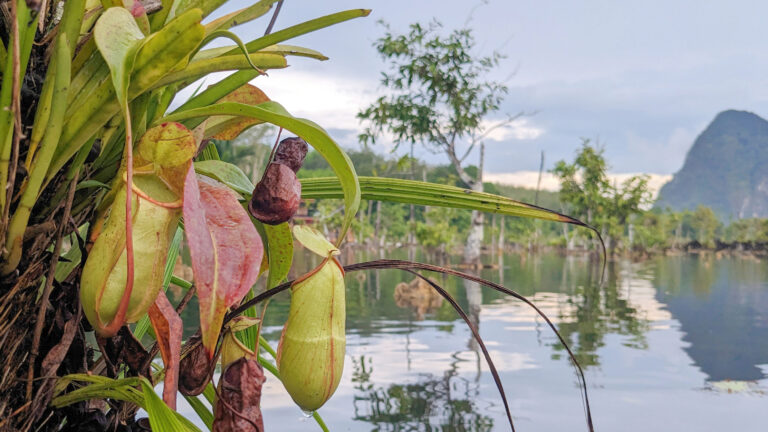
But once you see your first sundew, Nepenthes, Sarracenia, or Pinguicula, a new question naturally follows:

“Where do people actually buy these other species — and how do I choose the right one?”

That’s exactly why this guide exists.

To help you move beyond the limited selection in big-box stores and into the world of trusted specialist nurseries — places that grow carnivorous plants ethically, responsibly, and at a level of diversity you simply won’t find anywhere else.

This Preview Edition of The Ultimate Carnivorous Plant Nursery Guide gives you the essentials:

✓ trusted beginner species
✓ where to buy carnivorous plants safely and ethically
✓ how to avoid poached plants
✓ foundational care principles
✓ and a visual cheat sheet on how to grow a Venus flytrap, one of the most searched carnivorous plant care questions in the world.

Tip:

You’ll find the Venus Flytrap Care Diagram in Section 5 below.  A practical overview of what this remarkable species really needs.

At the end of this preview, you’ll also have the chance to download the full guide, including the global nursery list, beginner species recommendations, deeper care notes, and a behind-the-scenes look at Borneo Exotics — the world’s leading Nepenthes nursery.

If you’d like, you can download the full guide here.

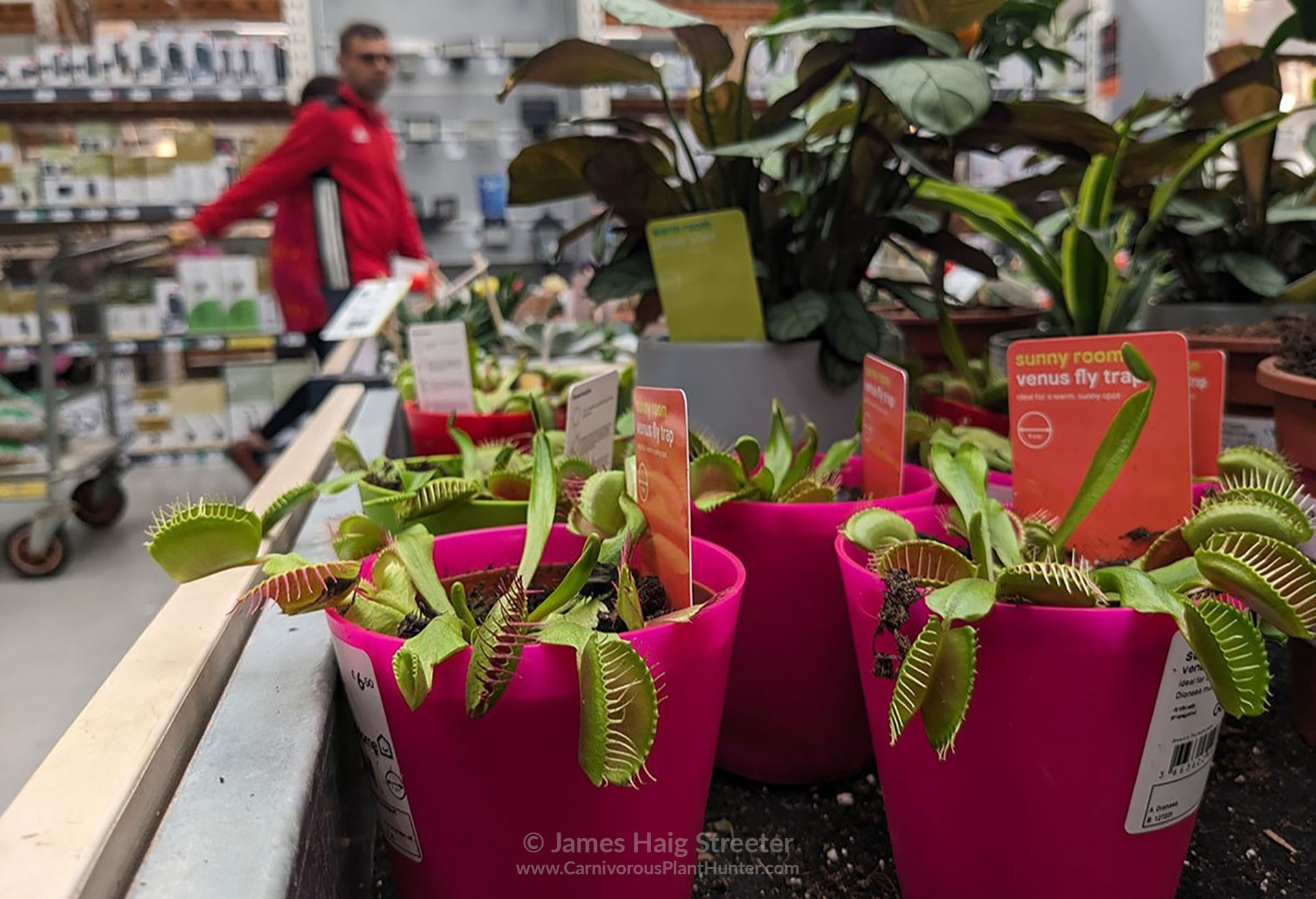
A typical small selection of unhealthy looking carnivorous plants at a garden center.

Photo credit: James Haig Streeter

1. Why a Nursery Guide Matters

Finding the right nursery is the difference between a thriving plant and a frustrating experience.

Carnivorous plants can now be found in garden centers, big-box stores, online shops, and independent nurseries. But while the options are increasing, not all sources are equal, and each comes with its own risks.

Here are the three most common problems beginners face when buying plants:

1. Big-box stores often sell stressed or poorly cared-for plants.

Venus flytraps and pitcher plants in hardware stores or supermarkets are often:

  • kept in low light
  • watered improperly
  • sometimes even fertilized (a death sentence for carnivorous plants)


Many new growers unknowingly start with a plant that is already declining — and assume they did something wrong.

2. Garden centers offer almost no diversity.

A typical shop might carry a flytrap or a single pitcher plant… if you’re lucky.

But in the wild, there are more than 800 species of carnivorous plant, plus hundreds of hybrids in cultivation.


To find healthier plants — and explore real variety — you need a specialist nursery that grows a wide range of: Sarracenia, Drosera, Nepenthes, Pinguicula, bladderworts, rainbow plants, and more.

This is where the hobby truly opens up.

3. Unknown online sellers may offer wild-collected plants.

This is the real sourcing danger — and it never comes from big-box stores.

Unverified sellers on marketplaces, social media, or generic plant websites may offer rare species at suspiciously low prices. These plants are sometimes taken directly from the wild, harming fragile populations and violating international law.


Buying from unknown sources risks:

  • unintentionally supporting poaching 
  • receiving plants that are stressed, damaged, or unacclimated
  • losing rare species that are difficult to replace

This is why it’s always the best option to buy from a reputable, specialist carnivorous plant nursery.

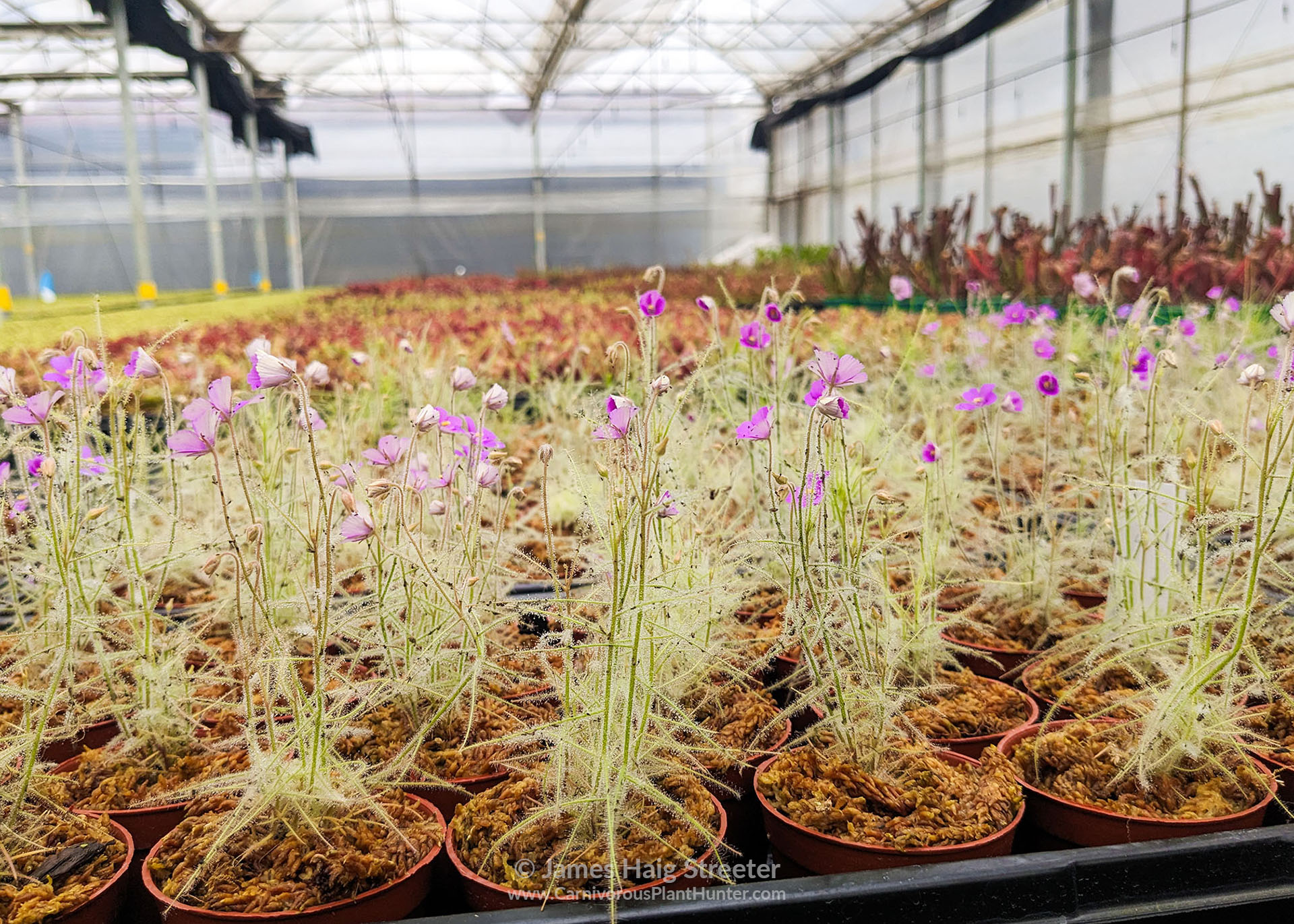
The carnivorous Byblis at a specialist nursery.

Photo credit: James Haig Streeter

2. What Makes a Good Nursery?

A reputable nursery will:

  • propagate plants ethically from legally collected parent stock

  • never sell wild-collected material

  • ship plants that are healthy and acclimated to cultivation

  • offer far more species and hybrids than any garden center

  • support conservation by reducing pressure on wild populations


Many specialist nurseries have spent decades building their collections legally and ethically. When you support them, you help preserve wild habitats by reducing the demand for poaching — one of the greatest threats facing carnivorous plants worldwide.


This is exactly why the full version of this guide exists.


It includes a curated list of the world’s best carnivorous plant nurseries — from Venus flytrap specialists in the US to Nepenthes growers in Europe, Australia, and Asia — so you can grow confidently and responsibly.

3. Choosing Your First Carnivorous Plants

Some species are famously forgiving. Others are famously not.
For beginners, the easiest (and most rewarding) plants usually include:

  • Venus flytrap (Dionaea muscipula)
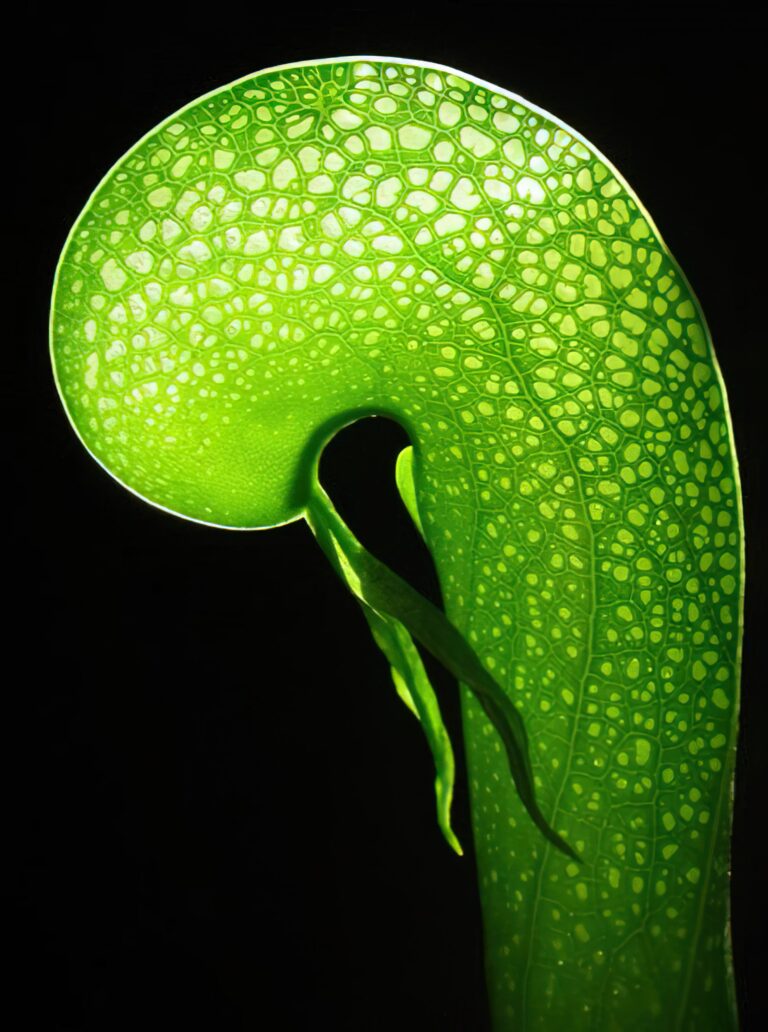
  • Sarracenia (North American pitcher plants)
  • Drosera (sundews; several excellent beginner species)
  • Nepenthes hybrids (tropical pitcher plants, especially “beginner” varieties)


Each of these groups appears repeatedly in global search data — meaning newcomers everywhere are trying to grow the same plants you are.


This Preview Edition touches on the basics, but the full version of the guide explains:

  • which plants are perfect for windowsills
  • which plants demand full sun
  • which species to avoid early on
  • how to choose healthy plants when buying online
  • how to avoid common beginner mistakes

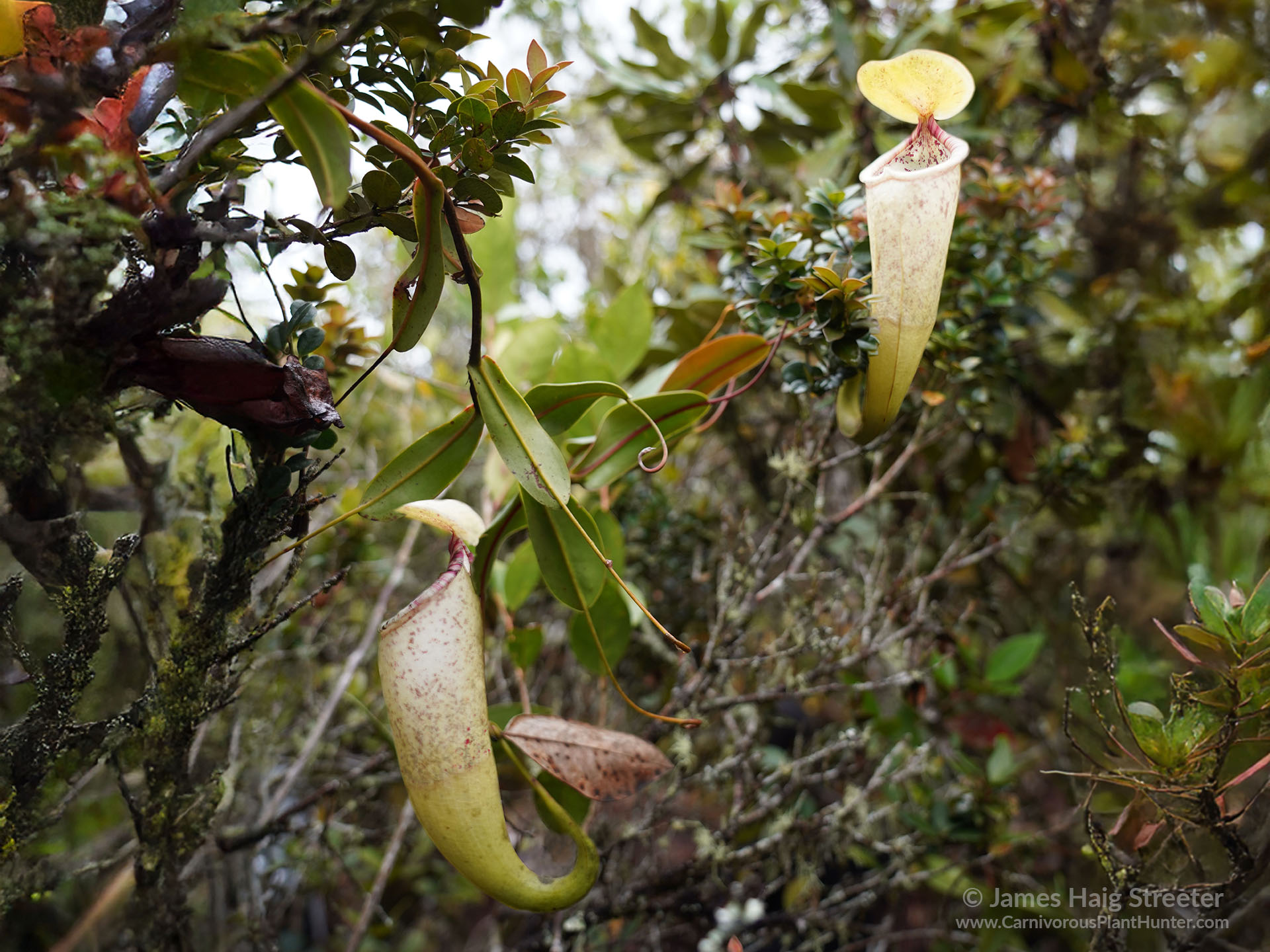
An unusual, CITES-protected, Nepenthes alba growing wild in the Cameron Highlands, Malaysia.

Photo credit: James Haig Streeter 

4. Avoiding Wild-Collected Poached Plants

Many carnivorous plants grow in tiny, fragile populations. When even a few individuals are removed, entire sites can collapse.  For this reason, many types are protected under international law, including CITES (Convention on International Trade in Endangered Species of Wild Fauna and Flora).

Conservation organizations and specialist societies generally recommend purchasing nursery-propagated carnivorous plants as a way to avoid supporting poaching and wild collection, a practice known to threaten fragile populations.

Red flags of wild-collected plants:

  • mature, oversized plants at suspiciously low prices
  • vague or missing origin information
  • claims like “rare wild form” from private sellers with no credentials
  • plants arriving stressed or dehydrated
  • sellers operating only via social media with no nursery name or address


If something feels off, trust your instincts and avoid the purchase.

The full guide includes how to identify poached plants and what ethical growers look like behind the scenes.

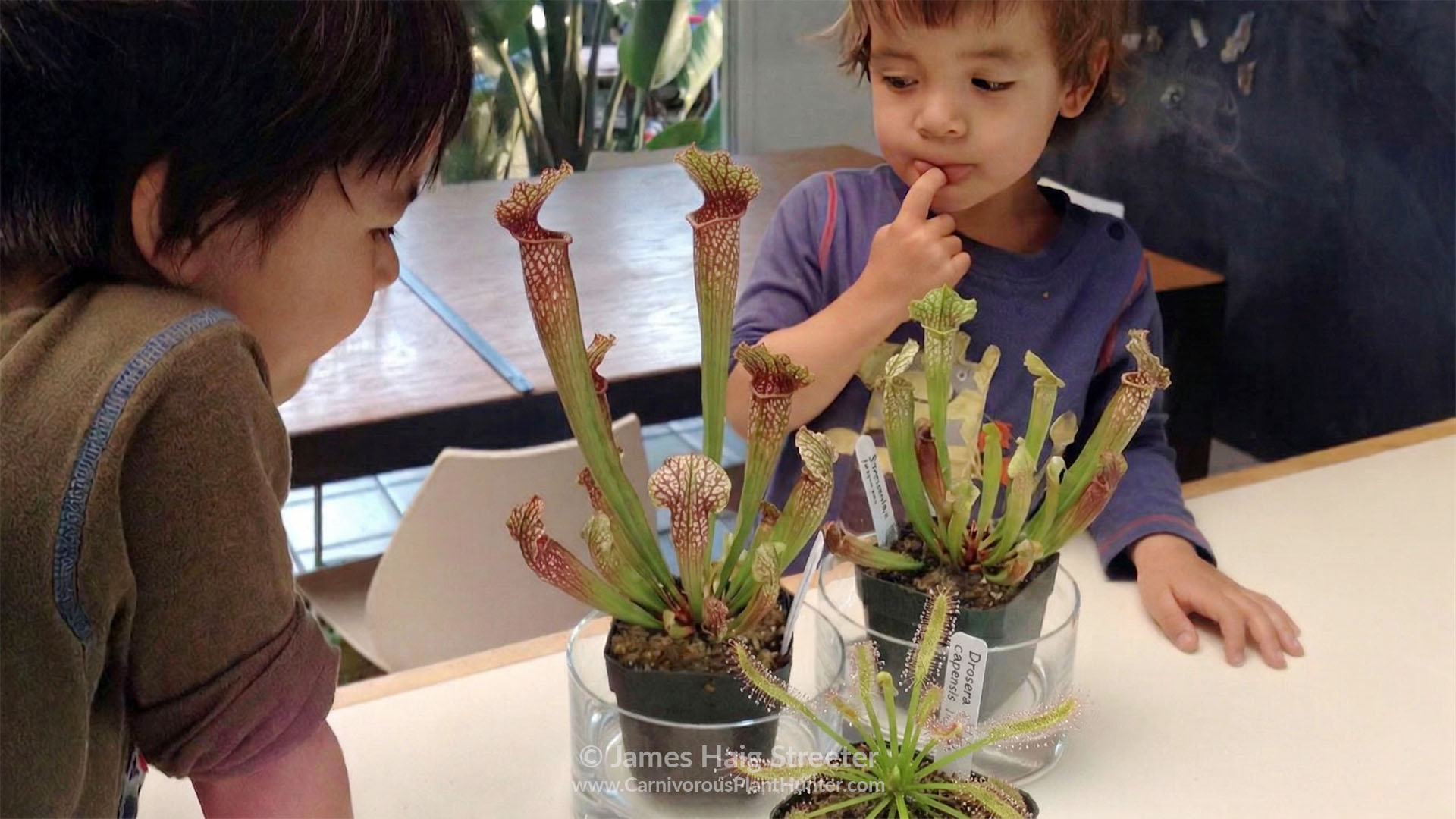
First carnivorous plants. “Will it bite me?”

Photo credit: James Haig Streeter

5. Basic Carnivorous Plant Care

What Every Grower Must Know

...and Why Natural Habitats Matter

Carnivorous plants have a reputation for being difficult to keep — but the truth is far more encouraging:

They’re much easier once you understand the natural environments they come from.

In the wild, they grow in nutrient-poor, waterlogged habitats that would kill most plants.  They evolved to become carnivorous to survive these harsh conditions.  Because of this, caring for them often means doing the exact opposite of what you’d do for a typical houseplant. 

Understanding these environments not only makes cultivation easier — it opens the door to understanding where these plants live in the wild, and why their ecosystems are so extraordinary. For many growers, this is where curiosity shifts from care to exploration.

Wild Environment

Home Care

Nutrient-poor soils

Do not use any fertilizer

Waterlogged environments

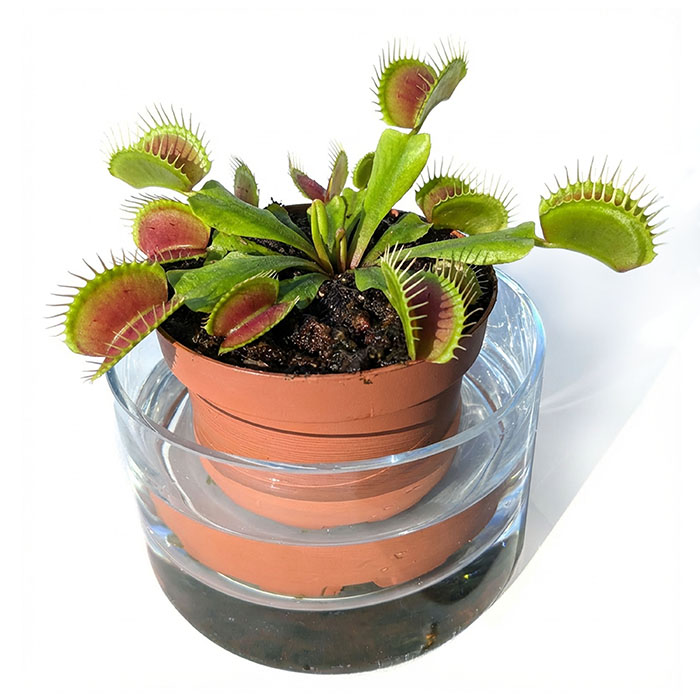
Keep pot standing in water

Low mineral/nutrient-free water

Use pure water (rain, distilled, or RO)

High light conditions

Bright light, often full sun

Seasonal change

May need winter dormancy

Eat insect prey

Will catch their own!

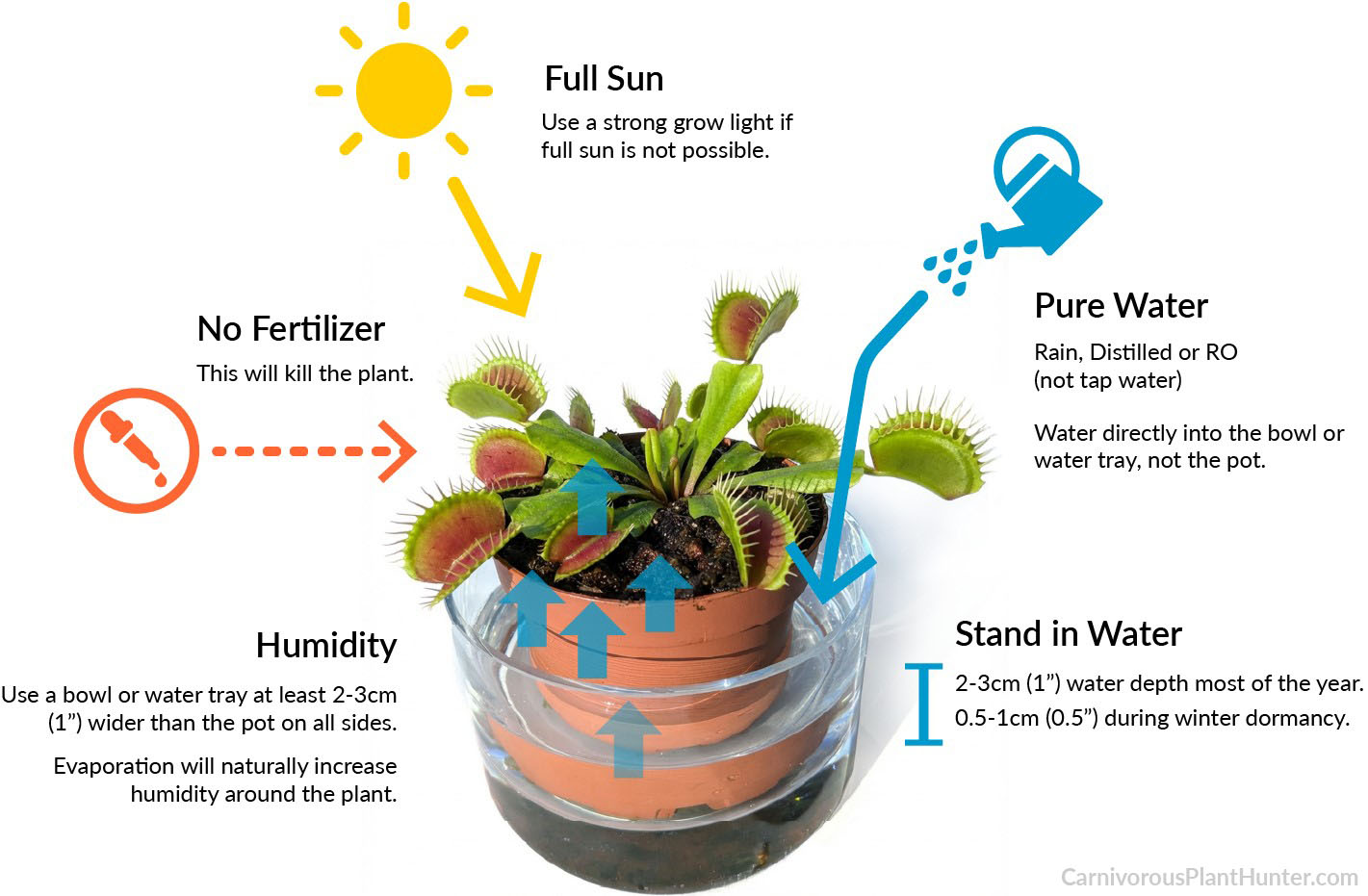
Venus Flytrap Care Diagram

Use this visual cheat sheet as a quick reference. It’s based directly on how Venus flytraps grow in their natural range in North Carolina: bright sun, wet soil, mineral-free water, and a winter dormancy period. 

When you start, it’s easiest to keep the plant pot in a bowl of water as shown in the care diagram.  But as you increase your collection of carnivorous plants, you can place many pots in a single larger water tray, which simplifies watering.

This is one of the most searched topics in carnivorous plant care worldwide — and this diagram gives beginners a reliable foundation while pointing experienced growers toward deeper habitat understanding.

The full guide expands further with:

  • water-quality charts
  • soil mixes
  • dormancy instructions
  • feeding tips (ok, if you know what you’re doing)
  • troubleshooting
  • acclimation guides for shipped plants

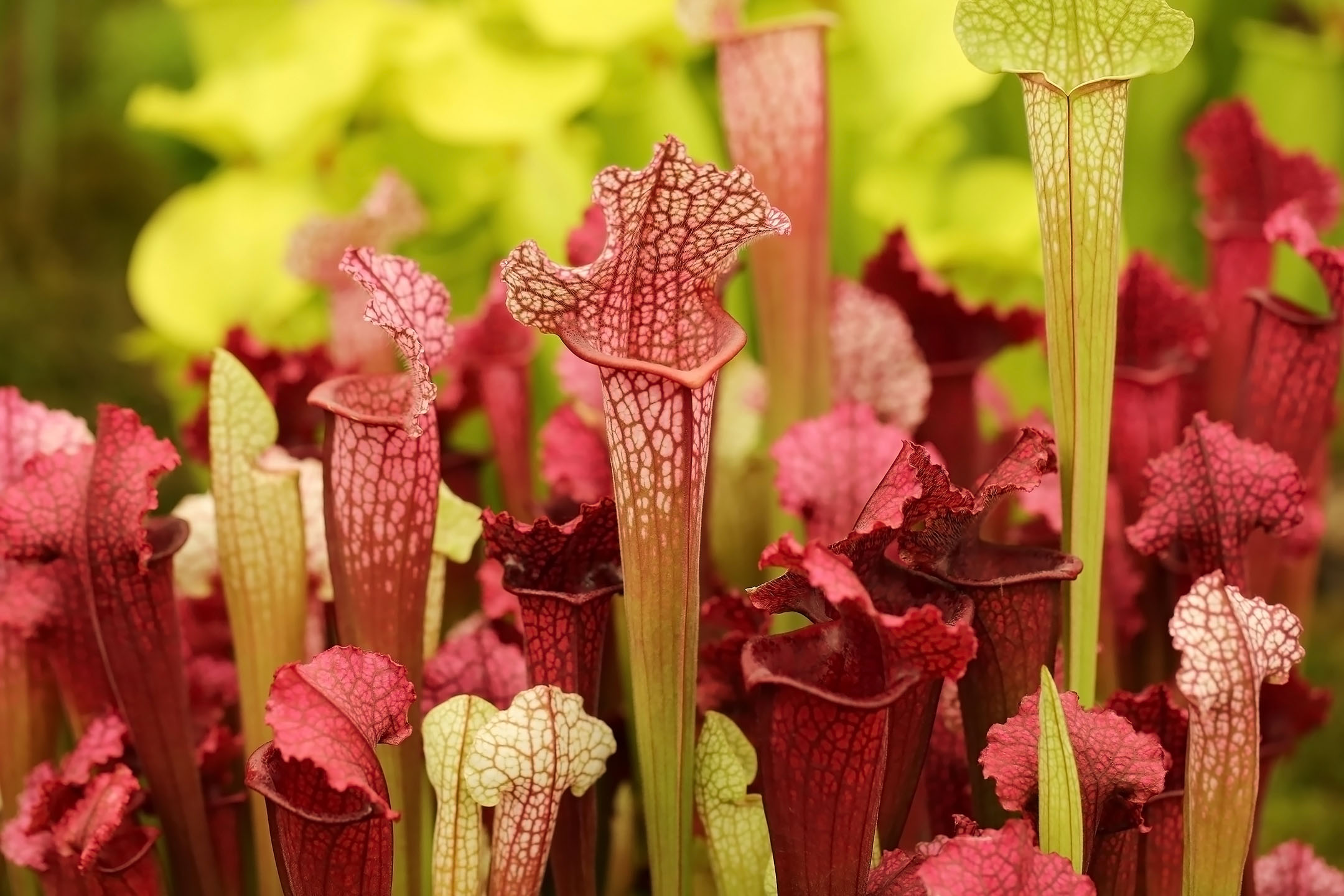
A selection of Sarracenia hybrids.

Image license: Adobe Stock

6. Why the Full Guide Exists

This Preview Edition gives you the essential foundation — but there’s so much more to explore.

The full Ultimate Carnivorous Plant Nursery Guide includes:


  • the curated global nursery list (US, Canada, UK, EU, AUS/NZ, Asia)
  • recommended beginner species by climate and experience
  • shipping + acclimation tips used by experienced growers
  • how to choose hybrids vs species
  • expanded care notes
  • how to avoid wild-collected plants with confidence
  • and a behind-the-scenes look at Borneo Exotics, the world’s largest Nepenthes nursery,  including how the Guinness World Record-holding pitcher plant was grown

It’s designed to be the single most useful beginner resource on the internet — and a trusted reference even for experienced growers.

Growing these plants is a way of connecting more deeply with the natural world — and every nursery purchase you make can help support ethical cultivation and conservation.

Want the complete guide — and more stories from the wild?

Download the free, full 62-page Ultimate Carnivorous Plant Nursery Guide to explore the complete global nursery list, deeper care advice, and a rare behind-the-scenes feature inside Borneo Exotics.

You’ll also join the Explorer’s Notebook — and be the first to hear about new field discoveries, wild habitats, upcoming Explorer Guides, and future evolution-focused features.

Explorer’s Notebook emails are occasional and meaningful. Unsubscribe anytime.

Share..

Follow..

About the Author

James is an award-winning landscape architect turned documenter of wild carnivorous plant habitats. He has spent decades tracking these remarkable species across the globe, guided by research, patience, and the joy of discovering plants in the places nature intended.

A member of the IUCN Carnivorous Plant Specialist Group, James founded the Carnivorous Plant Hunter to help people experience carnivorous plants in the wild, understand the stories behind them, and connect more deeply with the natural world.

What began as a personal project to map wild plant sightings has grown into a platform where exploration, science, and the wild world of carnivorous plants collide.

Recommended Next Articles...